The reality of modern flooding is that our margin for error is vanishing. We aren’t just dealing with predictable seasonal flooding anymore; we’re dealing with flash flooding events that can turn a car park into a lake in twenty minutes.
If your flood plan/strategy relies on a human being getting to a barrier in time, you don’t have a plan/strategy – you have a gamble.
The Problem with “Manual”
Traditional flood defences look great on paper during a dry Tuesday afternoon drill. But in a real-world crisis, things break.
- Road closures prevent your team from reaching the site.
- If your access gates need a power supply that just went down, you’re stuck.
- Even the best teams make mistakes when they’re cold, wet, and under pressure.
High-value assets, e.g. data centres and M&E plant rooms, can be ruined because a deployment window was missed by mere minutes. In flood protection, “almost fast enough” is the same as doing nothing at all.
Passive Systems: Set It and Forget It (Actually)
This is why there needs to be a shift toward passive flood defences. The logic is simple: let the water do the work.
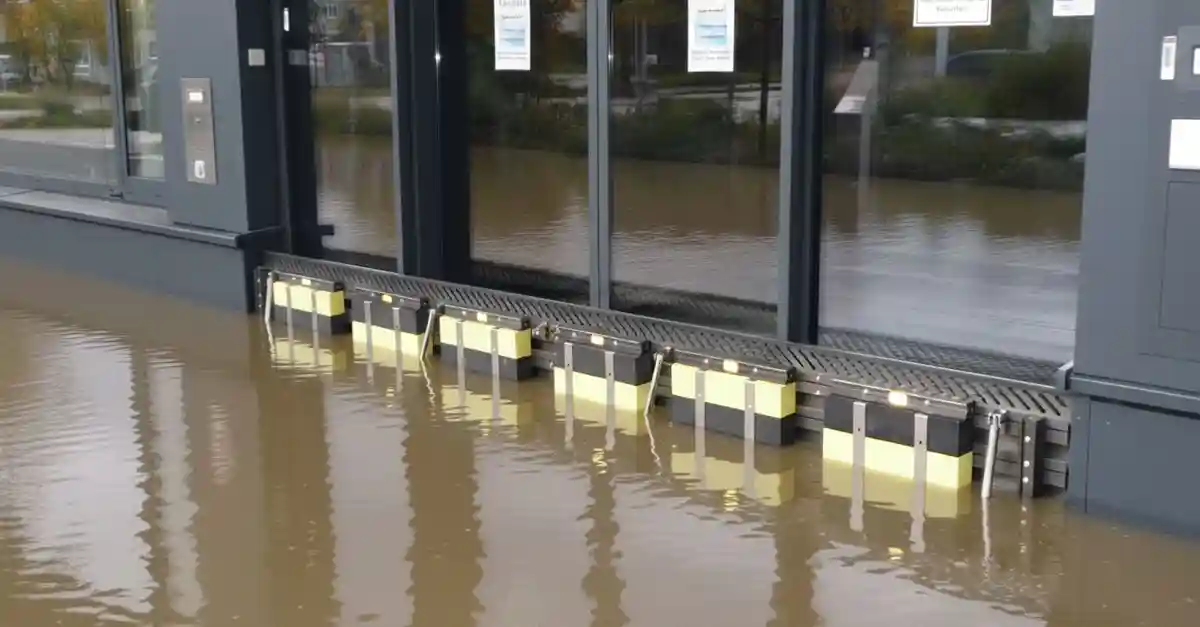
Instead of waiting for a sensor or a person, these systems – like passive flip-up or self-closing barriers, use the hydrostatic pressure of the floodwater itself to deploy. As the water rises, the barrier rises. No electricity, no frantic phone calls, and no manual lifting.
Why to spec. these more often:
- Zero Warning Required: You don’t need an SMS alert to warn you. It reacts to the physical reality of the water, not a forecast.
- Fail-Safe by Design: Without motors or batteries to fail, you’ve removed the two biggest points of failure in any mechanical system.
- True 24/7 Protection: It protects the site on Christmas Day, at midnight, or during a total blackout just as effectively as it does during a shift change.
The “First Line of Defence”
We’re not saying you rip out every manual barrier or pump on-site. Effective flood management is always about layers. But your first line of defence shouldn’t be a human being with a spanner. It should be a permanent, passive installation that doesn’t need to be “activated”, because it’s always ready.
Whether it’s protecting a basement car park entrance or a set of units on a business park, the goal is to reduce uncertainty. When the weather gets ugly, you need to know that the site is sealed before the first drop of rain even hits the ground.
If you’re at flood risk, kit reliability isn’t an option, it’s the difference between a boring Monday morning and a multi-million-pound insurance claim.